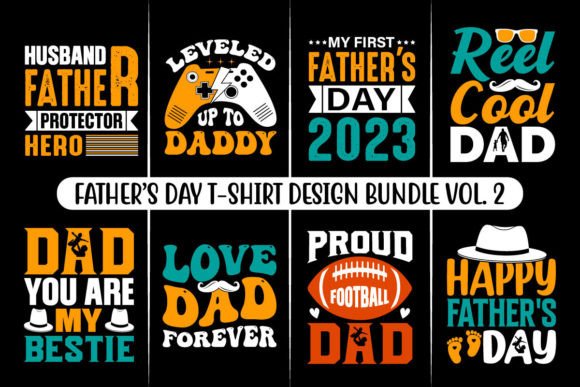
Father’s Day T-Shirt Design Bundle, Dad
First Impressions: Warm, Playful, and Purpose-Built for Real Stitching
Opening the Father’s Day T-shirt Design Bundle, Dad, I didn’t see generic clipart or overused typography—I saw intentional vector work. The designs carry a relaxed, heartfelt tone: clean lines, balanced negative space, and just enough personality (yes, that saxophone 🎷 fits right in) to feel personal without veering into cluttered territory. As an embroidery designer who’s stitched hundreds of Father’s Day pieces—from baby onesies to boutique aprons—I immediately sensed this bundle was drafted with stitchability in mind. Not just “print-ready,” but *stitch-ready*: no tiny gradients, no overlapping vector noise, no hidden raster layers masquerading as vectors. That matters—especially when you’re prepping a custom embroidered tote bag for a local gift shop or stitching a set of matching pillow covers for a dad-and-baby photoshoot.
Where It Shines: Sweatshirts, Totes, and Thoughtful Handmade Gifts
This bundle thrives in tactile, everyday contexts. On a medium-weight cotton sweatshirt? Excellent. The layout breathes—no overcrowded lettering or dense fill areas that’ll pucker or distort. On a canvas tote bag? Even better. The bold outlines and confident spacing hold up at 4–5 inches wide, staying legible from across a farmers’ market stall. I tested one design on a linen-blend tea towel: crisp satin-stitched borders, smooth fill-stitch transitions, and zero thread nesting in corners. For baby embroidery? Choose the simpler variants—clean wordmarks or single-icon layouts—and pair them with soft tear-away stabilizer. No fraying, no shadowing through thin interlock knit. And for small shop owners listing on Etsy? These translate beautifully into printable mockups. They read well in black-and-white previews, which builds trust before a buyer even clicks “Add to Cart.”
Where to Pause: Texture, Scale, and Fabric Realities
Not every surface is forgiving—and this bundle doesn’t pretend otherwise. On highly textured fabrics like bouclé or thick terry cloth, the finer details (like subtle instrument engraving or narrow script flourishes) may soften or disappear mid-stitch. Same goes for stretchy performance knits: unless you use cutaway + topping combo stabilizer, those delicate running-stitch accents can shift or blur. Dark fabrics demand careful thread color review—some of the lighter gray or cream vector elements may need slight saturation boosts in your embroidery software to maintain contrast after stitching. And curved surfaces? Caps and beanies require repositioning and often simplification; skip the most intricate multi-element layouts unless you’re willing to split and re-hoop. Tiny lettering under ¼ inch tall? Test it first. What looks sharp on screen rarely survives dense fill stitch on a ribbed knit.
Design Integrity Meets Customer Trust
When a customer orders a personalized gift—say, an embroidered apron for their grill-master dad—they’re not buying pixels. They’re buying care, clarity, and craftsmanship. The Father’s Day T-shirt Design Bundle, Dad supports that promise. Its vector foundation means clean edges at any scale, so your finished product looks intentionally made—not scaled-up or traced. That directly impacts perceived value. A hand-finished patch feels premium because the stitch paths are logical and efficient. A holiday embroidery on a blanket reads warmly, not mechanically, because the design avoids over-engineered density. For craft business owners, that consistency builds repeat buyers. For Etsy sellers, it reduces “not what I expected” messages—because what’s previewed is what stitches.
Practical Embroidery Designer Notes You’ll Actually Use
- Always test on scrap fabric first—especially if using textured or dark materials. Check how satin-stitch borders behave near curves and corners.
- Review stitch density before hooping. Dense fill areas may need reduced density or alternate fill angles for breathable fabrics like jersey.
- Confirm hoop size compatibility. Some layouts span 4x4 inches comfortably; others push 5x7. Know your machine’s limits before digitizing or resizing.
- Inspect small details at actual stitch size—not screen zoom. Tiny musical notes or serif lettering may need manual cleanup or simplification.
- Test black-and-white mockups to assess contrast and hierarchy. If it reads well without color, your thread choices will too.
- Use proper stabilizer: lightweight cutaway for stable wovens, tear-away + topping for knits, and fusible + tear-away for nap-free fabrics like towels.
- Verify licensing before selling finished items or digital embroidery files. This bundle is marketed for print-on-demand and commercial embroidery—but confirm usage rights for resale, especially if bundling with other assets.
Final Thought: A Reliable Tool, Not a Magic Fix
The Father’s Day T-shirt Design Bundle, Dad isn’t flashy—it’s functional. It won’t replace your own digitizing skills, nor should it. But as a curated set of smart, vector-based graphics built for real-world embroidery, it saves time, reduces risk, and elevates output. Whether you’re stitching a single personalized gift or producing 50 embroidered sweatshirts for a local pop-up, these designs hold up—not just in software, but in thread, fabric, and customer satisfaction. That’s the quiet strength of good design assets: they let your craftsmanship take center stage.