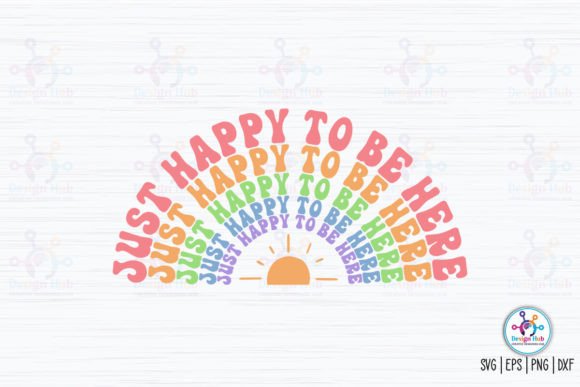
Just Happy to Be Here Retro SVG
A Designer’s First Glance: Warm, Worn-In, and Wonderfully Uncomplicated
Opening Just Happy to Be Here Retro SVG feels like flipping through a well-loved vintage postcard—soft edges, gentle curves, and that unmistakable mid-century charm. It’s not flashy or fussy; it’s friendly, grounded, and quietly confident. The lettering leans slightly rounded, with subtle weight variation and a relaxed rhythm that reads as handwritten—but polished. No sharp corners, no aggressive kerning, no forced “vintage” distressing. That matters. In embroidery, where stitch behavior amplifies every design decision, this kind of intentional simplicity is a gift—not just aesthetically, but functionally.
Real Project Test: Embroidering a Linen Tote for a Local Boutique
Last week, I prepped Just Happy to Be Here Retro SVG for a small-batch run of linen tote bags—intended for a neighborhood coffee shop’s loyalty program. Linen’s slubby texture and moderate stretch demand clarity in line work and thoughtful stitch planning. I resized the design to 4.2" wide (a comfortable fit for standard 5x7 hoops), mirrored the layout for front-center placement, and ran a quick test on scrap fabric with medium-weight cutaway stabilizer. What stood out immediately was how gracefully the curves translated into satin stitch—no puckering, no skipped sections, even across the gentle arch of the “h” and “e” in “Here.” The phrase flows like spoken warmth, not rigid typography—and that translates directly into how customers *feel* holding the finished product.
Where This Design Shines (and Where It Asks for Thoughtful Handling)
Just Happy to Be Here Retro SVG excels in projects where mood and message matter more than intricate detail:
- Custom apparel: Works beautifully on sweatshirts, crewnecks, and lightweight hoodies—especially when stitched in tonal thread (heather grey on charcoal, oatmeal on natural) for quiet sophistication.
- Personalized gifts: A baby onesie? Yes—scaled down to 3", it reads clearly without crowding delicate seams. A holiday tea towel? Perfectly balanced between nostalgic and fresh.
- Craft business essentials: Ideal for small shop merchandise—aprons, pillow covers, canvas pouches—where handmade authenticity is part of the brand voice.
- Etsy seller assets: Clean vector outlines make it easy to build printable mockups, digital previews, and layered branding kits without pixelation.
But let’s be practical: this isn’t a one-size-fits-all embroidery file. Use caution on:
- Very small hoop sizes (under 4"): The lowercase “a”, “r”, and “e” rely on smooth curve continuity—shrinking too far risks loss of legibility in fill stitch.
- Highly textured or stretchy fabrics: Knits and ribbed cottons need extra stabilizer support under satin-stitched curves to prevent distortion.
- Dark or dense fabrics: While the design’s open spacing helps, avoid ultra-thick fleece or double-layered caps unless you’ve tested thread coverage and density first.
- Curved surfaces like structured caps: The horizontal flow works best on flat or gently contoured areas—avoid placing near the crown seam unless re-digitized for cap curvature.
What It Adds to Your Finished Product—Beyond the Stitch
This isn’t just another machine embroidery design—it’s a subtle trust-builder. When a customer sees Just Happy to Be Here Retro SVG stitched cleanly on a handmade tote or nursery pillow, they don’t just read the words. They register care: in the even tension, the intentional spacing, the lack of visual clutter. That perception lifts perceived value. For Etsy sellers, it supports cohesive shop branding—pair it with soft neutrals and natural fibers, and it quietly signals intentionality. For craft fair vendors, it’s conversation-starting without being loud. And for personalized gifts? It lands with sincerity—not irony, not trend-chasing, just genuine, unhurried warmth.
Practical Designer Notes Before You Stitch
Before committing to your first production run:
- Run a test on scrap fabric matching your final project’s weight and texture—especially if using knits, linen, or blends.
- Check thread color contrast on both light and dark backgrounds. Some retro palettes look warm on screen but mute on fabric.
- Review stitch density in curved areas—the original files may assume standard density; adjust if stitching on delicate or loosely woven cloth.
- Confirm hoop size compatibility. If working with smaller hoops, verify whether the design fits comfortably without compressing key letterforms.
- Inspect tiny details at actual stitch scale: the inner counter of the “e”, the tail of the “y”, the connection points in “to” and “be.” These define clarity.
- Test black-and-white mockups. Does the phrase retain its personality without color? It should.
- Use appropriate stabilizer—cutaway for knits and wovens, tear-away for stable cottons, and always match stabilizer weight to fabric drape.
- Verify licensing terms before selling finished items or bundling Just Happy to Be Here Retro SVG as part of a digital product. The listing confirms it’s suitable for small business use, but commercial embroidery rights depend on the creator’s specific terms.
Final Thought: A Quiet Workhorse, Not a Flashy Gimmick
In a landscape crowded with overdesigned, overdigitized graphics, Just Happy to Be Here Retro SVG stands out by doing less—so the maker can do more. It doesn’t shout. It doesn’t demand attention. It simply holds space, warmly and honestly, for what matters: presence, craft, and the quiet joy of making something real. Whether you’re an embroidery designer building a trusted library of design assets, an Etsy seller curating meaningful small shop products, or a hobbyist stitching a heartfelt gift—this is the kind of embroidery file that earns repeat use, not one-off novelty. It belongs in your Crafts toolkit, not as decoration, but as reliable, human-centered Graphics that stitch true.